
A propane tank is usually 20lbs and typically used in patio, back yard cooking. A picture is here  .
.
A propane bottle is 1lb and typically used in camping/hiking. A picture is here 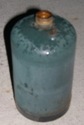 .
.
A propane tank is usually 20lbs and typically used in patio, back yard cooking. A picture is here .
A propane bottle is 1lb and typically used in camping/hiking. A picture is here .

Quick dis-connector serves a couple functions:
1. You can swap different equipment to use the same natural gas pipe. Not only you may have an outdoor stir frying stove, you might have a grill.
2. Once you are done with cooking, you can disconnect the stove completely from the gas line. This might give you peace of mind that nothing is leaking.
The non quick dis-connector option, i.e., an EF11LN50WG stove connects to the gas line permanently.

Jon F. : Hi, I have been interested in your product for some time now, but am a little confused about the differences between stoves. I am a serious cook and cook a lot of Chinese food. Stir frying is always a challenge on a home stove.
I often cook for more than 5 people
With the most powerful powerflamer stove, is there continuous flame? Can I lower the flame? I don’t necessarily need to simmer, but many stir fry dishes require that heat be raised and lowered depending on what ingredients you are adding.
How important is it to have the protections mentioned? Do all of your models have protection? I don’t mean the wind guard, I mean the thermal coupler and propane tank. I don’t eant the tank to blow up in my face!
Manual ignition is good. Tall legs, that can be removed for table top cooking, is good.
Also, I live in upstate New York. I understand these units must be used outside, and that there is a wind guard. Can they be covered when not in use? Will they work when the surrounding temperature is cold?
I guess the most important question is, can I use the most powerful stove and still be able to adjust the flame, and is the adjustment continuous?
Outdoorstirfry:
Based upon what you ask, the PF13L160 stove should be the best fit for you – most powerful stove + continuously adjustable. Please look at https://outdoorstirfry.com/?page_id=1180. It has manual ignition and a pilot light enabling you to turn off the main burner between dishes.
In terms of protection, there is a valve on top of the propane tank. You turn it off after cooking and in emergency. The stove also has one valve for the main burner and another valve for the pilot light. You can turn them off quickly in case of emergency. Stir frying is relatively safer than other types of cooking because operator needs to standby during cooking. So you would be able to react fast enough on valves.
Any size wok will be able to sit on top of PF13L160 stove and be steady. However since the stove dimension is about 13”, optimal size would be 14″ to 18″.
Here is a typical way to maintain an iron ware if it does not have a non-stick layer. For caring a non-stick iron ware, you can go to Product_FryingPan.
During storage, iron ware should not have any water. Ideally it should be wiped with a layer of cooking oil before storage;
After cooking, wash and clean thoroughly with water. Put the iron ware back to stove to dry out any moisture. Then apply a layer of cooking oil before putting it away;
Hope above helps. In your case, since you already observe rust, you can bring it out and polish the rust off with a steel cleaning ball and water. Then follow step #2 above to store it away. Any moisture will bring back the rust.
Here is 3 steps offered by http://www.ehow.com/how_2247902_prepare-season-wok.html:
———————
Here is another 4 steps method:
——————————-
Cast iron cookware has long been a much beloved tool to many a serious chef. Seasoning cast iron cookware helps provide a non-stick surface, and helps prevent rusting. And when seasoned properly, your cast iron can last a lifetime! Let the foods you cook with your cast iron cookware be full of delicious flavor, not buildup, rust, or stuck on grime!
For NEW or Old Cast Iron Cookware, Just SEASON IT!
If your cookware has been around for a while, it may have rust and/or thick black buildup. It can be restored! Old & New Cookware will benefit from Seasoning!
——————–
In today’s busy society, it might not be easy to maintain an iron ware. That’s why we do not recommend using iron wok only on our web site. Our stove products are powerful enough to compensate the inferior heat transfer of stainless wok as compared with an iron one. For a video please see “Seasoning Process By Ala Luke“.
If the stove is heavily used, such as to cook a couple dishes every day, its life expectancy is about 10 years.
Main concerns: He read the propane (camping) bottle about how to store it. The label on the bottle says: store in a cool place under 120 degrees (F). He said that he put the bottle in his garage, but his garage can be hotter than 120 degrees.
Answer: It is true that we should not store a propane bottle anywhere above 120F. Since inside house is the coolest place compared to yard and garage, storing propane bottle inside house maybe the safest way. Consider a few excerpts of an article “A Safe Fuel” from National Propane Gas Association http://www.npga.org:
Then the question to ask ourselves is: since we park our cars in our garage too, will the gasoline tanks in our cars get into trouble earlier than a propane bottle/tank? For more safety information, we recommend to visit the National Propane Gas Association web site http://www.npga.org.
We always recommend caution when operating with propane gas. Especially when it is new to you, always give yourself extra time to become familiar with the setup before operation. If you are comfortable in using a grill, you should not feel any difficulty in using our stove. More information and why propane is a safe fuel source can be found in The National Propane Gap Association web site http://www.npga.org.
Most gas stations sell the tank and gas together. Alternatively, hardware stores sell empty tanks and some of them sell propane gas filling too. A lighter (same as grill lighter) can be picked up at any hardware store or hardware section of drug stores (e.g. Longs Drug). We are strongly against using matches.
Feedback: He said: First of all, you have to use it in the backyard, so you have to get all your ingredients there. Then you can’t put things on the grass, so you’ll have to set up a table. Then, after you cooked a dish, you’ll have to rush back to the kitchen, which is far away from his backyard, and wash the wok. Then come back for the second dish, wash the wok, and so on. “Yeah, the cooking time is shortened, but I spent more time rushing in and out of the house.”
Answer: I appreciate this feedback. My neighbor (an American), who has been using one of our sample stoves for a while now, also has the same comment. We are working hard coming up solution for this. So far we setup a table for all ingredients and have a tray of all spices. The table is setup besides the stove. We move all ingredients and the spice tray before starting the stove to cook. Some of our video demos show this arrangement.
Another trick is to organize and cook white dishes together and then black (or red) dishes. White dishes use salt and sugar as the main spices while black ones use soy sauce or any colorful spice. Additionally, we cook fish/sea food dishes at the end to avoid fishy taste on our vegetable dishes. We have to admit that not able to wash our wok in between did pose a problem to us at the beginning. By following some simple sequence, however, we never have to wash our wok in between any more. Hope this helps.