Posted on

Is there much difference between the manual ignition version PF13L160 and the electronic ignition version PF13L160EI?

Inquiry

Is there much difference between the manual ignition version PF13L160 and the electronic ignition version PF13L160EI?

Outdoorstirfry:  

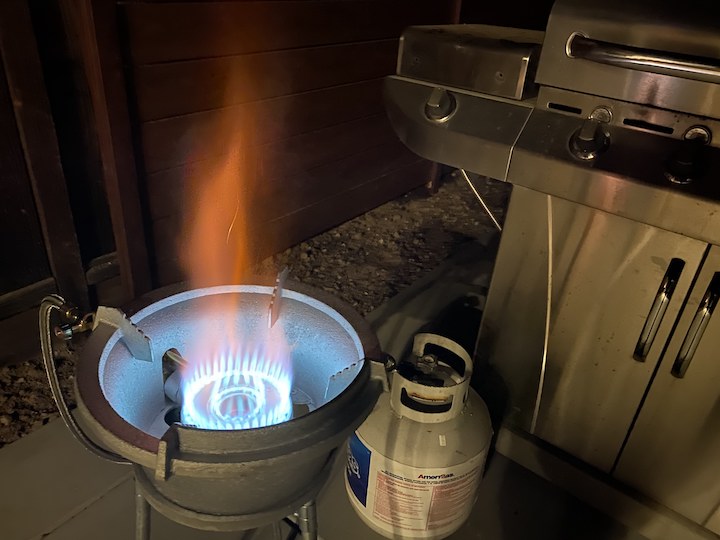
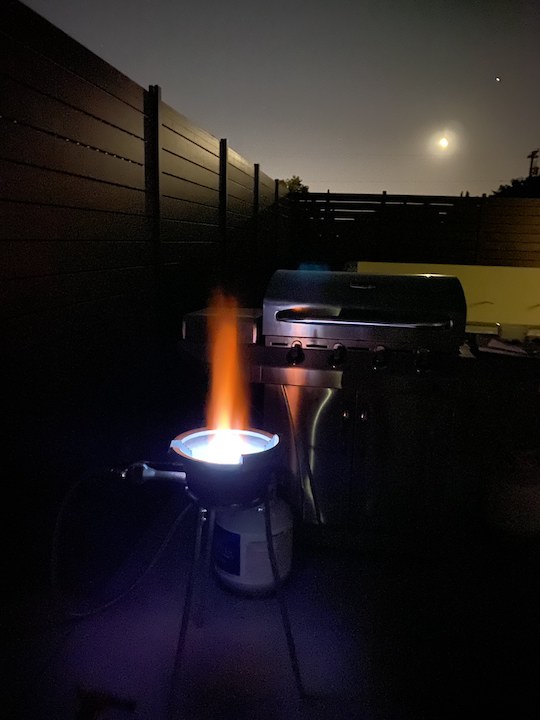
PF13L160EI has an electronic ignition head.  It usually takes 3~5 strikes to ignite a flame on the ignition tube end.   Once the flame on the ignition tube end ignites the main burner, you will need to turn off the ignition tube flame to avoid damaging the ignition wire.  If you stop the main burner between cooking dishes, you will need to repeat the ignition process for each dish.

PF13L160 has a pilot light and requires manual ignition.  You would ignite the main burner at low flame first by turning on the left valve.  Then turn on the pilot flame by turning on the right valve.  Adjust the pilot flame to appropriate flame size (~0.5 to 1″ in length of flame).  The pilot flame stays lit between cooking dishes.   If you turn off the main burner between cooking dishes, you only need to turn on the main burner for cooking next dish (no need for any more manual ignition).   Because of its simplicity PF13L160 offers better reliability.  

Posted on

Inquiries for PF13CL160

Inquiry:

Hello, I was interested in the PF13CL160/PF13L160 and had several questions that I hope you can answer.

    – How long is the installation process?

    – Do you have a video of how to put the burner together?

    – How difficult is it to put together?

    – CL version indicates it is configurable to either a tank or a bottle. Is it easily interchangeable between a tank or a bottle?

    – What is the process of switching back and forth?

    – Long Leg Stabilizer (accessory): How is this installed on the long leg? I see the the usage example and it looks very helpful.

    – Pilot Light: I was reading the response in the process of the pilot light. I always understood it as lighting the pilot first and then it powers the burner but is it different for propane gas where we have to light the burner first and then the pilot light?

    – If I was to order both the burner and the stabilizer, is there a discount on shipping?

Thank you for your time and help. I understand ordering is on pause.Take your time in response. I am excited about your product and hope I can place an order soon.  Stay safe.

Outdoorstifry: 

  1. We provide a user installation when ship. You will just put up the long legs and connect to a tank after the stove arrive.
  2. We provide a user guide in PDF.
  3. Very easy.
  4. There is an adaptor for the 1lb bottle. You will just screw the adaptor into the regulator connector before screwing the 1lb propane bottle on to it.
  5. you unscrew the adaptor out to expose the tank connector.
  6. If you zoom out the bottom of the long legs of the first example picture, the stabilizer is screwed and tighten onto a long leg.
  7. Because the high pressure gas, it is somewhat difficult to set the pilot knob correctly initially. We recommend to light the main burner using a long nose BBQ ignitor first, then adjust the pilot with the main burner on.
  8. We will refund the extra shipping charge after shipping.
Posted on

Pilot light

Customer (PF13S160): 

I received the stove today. Thanks for shipping quickly. 1 question i have is regarding the pilot light. I’ve read many discussion regarding the pilot light on your website, but I’m still not clear.

While I do agree the pilot flame works the best when it’s 1-inch in length, but in order to achieve that 1-inch flame, the valve can only be cracked open very very slightly. It is very hard to control. Oftentimes, I would turn the valve too high, and the air flows too fast. As a result, the pilot light cannot be successfully lit. The second it’s lit, it will blow itself out.   

I notice on the brass nozzle of the pilot flame, there are 2 holes on the side. Are those the air inlet? If I cover up one of those holes, the pilot flame can be lit much easier. Do you think this is a good work around to cover up one of the inlet? I don’t want to use the stove not as intended, but right now, the pilot light is very finicky, and it would take me several tries to get it lit, especially, if it’s bright outside, and I can barely see the blue flame. 

Outdoorstirfry:  

If you cover up one air inlet hole and observe that the pilot flame can be more steady, please do so.  The procedure for the pilot light is to light up the main burner first.  With the main burner lit, you can light up the pilot light easily and adjust the flame by adjusting the pilot valve.  Since the valve assembly receive high pressure gas and the pilot only needs a tiny bit of gas to light, there is a fine adjustment to achieve a steady flame.

At home we usually cook a couple dishes at a time, we choose to light up the main burner by BBQ ignitor while not using the pilot at all. 

Customer:

Thanks for the reply. Pilot is important to me because I have to turn off the main burner often, to add seasoning. I think I’m gonna try turning on the main burner first before adjusting the pilot. Thanks. 

Outdoorstirfry

You have interesting cooking technique.   We actually prepare everything including seasonings before start the stove flame.   Actual cooking time is very short and we don’t need to re-light the stove.  

Customer

I like to full-power it when I’m tossing the food, but it also means the wok temperature gets really high. When I set the wok down to season and taste, if I have the flame still going ( even at medium setting), it will for sure burn the food. So instead try to turn it to the lowest setting, I might as well turn it off. Once I season, combine, and taste, then turn the fire back on to finish cooking. 
 
Also, having pilot light means I no longer have to reignite it when cooking the 2nd dish. 
 
Outdoorstirfry

You might get too much used to your previous stove of only two flame settings that you criticized in your earlier email.   PF13S160 flame power is continuous.   You can turn down to really low flame for simmer purpose.   This should give you another option beside turning the main burner fully off and then using the pilot flame to re-ignite.   I still find your way of cooking fascinating.   I hope your wok can retain heat well between your various phases of full power for one dish.  Otherwise you are heating the wok multiple times just to get back up to the same temperature.  

Customer

I use a 14-gauge 14inch wok, about 2mm, I think. it’s a little heavy.. Honestly, I find that if I keep the burner at full power, it would be too much for any dish. If I turn the burner off, and don’t add additional ingredients, it can maintain a sizzle for a long time. 
 
When I’m seasoning, I have to leave the food stationary for up to 10~30 seconds… so during that time, I can’t have the flame at high power. Yes, I could turn it to low heat, but i think it’s easier to just turn off, then turn the flame back after seasoning. 

Posted on

I’m just curious.

Customer (PF13S160):  

Thanks for the tracking #. Probably like many others, I purchased this stove after Kenji’s review. I hope you guys have a boom in business! 
 
Looking up the history of your company, it’s very impressive. Can you educate me on which products are the ones you have full design control over? and which ones are joint effort with the factory (ODM model)? 
 
I’m asking because your NG stoves all look very unique, and has an impressive flame for a home range. However, your propane one (this particular powerflamer) is very similar to those generic branded “fast stove” you can find at Chinese restaurant supply stores, for a very similar price range. I’m just wondering regarding your team’s design process with this particular model. Did you base on the generic “fast stove”, and add a few improvements? or is this completely different than the others on the market. 
 
Again, I’m just curious. I still chose your product at the end because I saw your great support you give to your customer on your website, and it is not more expensive than other stoves on the market. I’m just interested if there is additional advantage to your PF13xx160
 
Outdoorstirfry:  
 
Thank you for your question.   Our products are all based upon existing market products, then improved upon by our own usage experience, engineering talent and knowledge.   When we first came to USA, we had a need to stir fry.  We bought a “stir fry” stove from local Wisconsin market.  The stove was made by a company in Louisiana area which was famous in deep frying turkey type of cooking.   During the first stir fry my fingers got burned by the flame.   My friend in Wisconsin helped me to improve it to my own specifications.   When we left Wisconsin, we were granted a few patents from USPTO.  By worrying how to pay the due patent fees, we decide to try to sell to general public.   PF13x130 is the stove from those patents.

Our PF13x160 series is also based upon existing products.  In fact our CM in Asia has to sell their generic version beside supplying to us.   Otherwise they would not survive.   The PF13S160 stove to arrive to you has so far 3 of our patents – improving areas like stability, reliability, safety, outdoor weathering, flame control and tank compatibility etc.  The look of our PF13x160 might be similar to what our CM sells to other vendors from which you supply a link with.   Only using ours will get the benefits accomplished by us along the last 15+ years in solving those problems. 

We are capable of doing the design and development ourselves.  We don’t use ODM model. Bests.

Customer

Thanks for the insight! Look forward to the stove. 

I have purchased a couple of fast stoves in the past. The one I purchased 10 years ago, has a 大字形 nozzle, and had a pilot flame, and good flame control. I gave it to my dad so I no longer have it. I can no longer find this model on the market. 

Then I purchased another one like the one in the link below, and it was terrible. The flame control was very bad. It’s either full flame, or medium flame, or off, no in between. There is also no pilot light, so the flames die on me very often. 

https://wokowner.com/what-is-a-wok-burner/  

Outdoorstirfry

PF13S160 solves the problem you describe for the link you gave.   PF13S160 flame control is continuous.   We would love to see a sketch or picture on your dad’s 大字形 nozzle stove. 

Posted on

recommended clearance

Inquiry: 

Hello, I am considering purchasing PF13L160EI, however I only have a small porch. Would like to know your recommended stove clearance so I can see if i can fit it.  Thanks!

Outdoorstirfry:

The flame will typically surround the wok bottom surface and come upward.  If you have stucco wall, we recommend 1 foot clearance.  If you have wood wall, we recommend 2 feet clearance.  Hope this helps.

Posted on

Wok thickness

Customer (PF13L160): 

Hello,  What thickness is the carbon steel of the 14″ wok you sell?   Also, I saw a 1mm 14″ wok for sale on another web site (carbon steel) – is that too thin for your wok burner? Thanks.

I have just received your wok burner the 160,000BTU one manual start. I am so keen to start using it.

My main object is to achieve the wok “hai” flavor. When I cook noodles etc. will the “hai”taste come automatically or do I have to visibly burn them a little to get that taste?

Many thanks!!!

Outdoorstirfry

Our wok thickness is close to 2mm.  The heavier the wok, it is easier to retain heat.  But of course it is heavy and sometime hard to handle. 

In term of the “wok hei”, can you read our page at https://outdoorstirfry.com/?page_id=399.   You will have to try it out yourself in term of getting the right amount of caramelization.

Customer

Thank you so much for your prompt reply.  Also thank you making such a great wok burner!  
 
Cheers and thanks,
Posted on

Oil spill

Customer (PF13S160EI): 

Hello!  I hope you are well. I have a question for you if you have time.  I was deep-frying fish last night and had an oil spill onto the burner of my stove, now half of the ring does not burn.  Will this fix itself over time?  Should I unscrew the top plate to clean it?  Thank you for any help!

Outdoorstirfry

I guess you mean half of the burner has no flame.  Yes you need to unbolt the top plate to clean the burner and also make sure all holes on the top plate are through and clean.   I guess the oil just occupies half of the holes.  If not cleaned they might be harden in the holes. Hope this helps.

Customer

That does help! I’ll do it!  Thank you!

I couldn’t get the burner ring out. I unscrewed the screws, but they wouldn’t come out all the way, though they’re very very loose.  But it seems like the burner plate is attached inside to the entire unit.  Could I try to clean it without taking the plate off?

Outdoorstirfry

There are two nuts underneath the burner above the base plate.  Were you able to loose those couple nuts?   After loose these nuts, you should be able to pull the bolts off from top of the burner plate. 

Customer:

Aaah! Thank you, I’ll try that!

Posted on

I have a few questions.

Inquiry

What is the difference between the Power Flamer 130 and the Power Flamer 160?  One is stronger?  Are there any other differences?   When would you recommend the 130 and when would you recommend the 160?

Outdoorstirfry

130 has a 4″ burner and 160 has a 6″ burner.  160 flame is stronger.   130 is half weight as 160.  We recommend 130 for casual cooking and road trip.  For everyday cooking, we would only recommend 160.

Inquiry

How much control do you have over the flame? Is it continuously adjustable from low to high? Or are there discrete settings?

Outdoorstirfry

both 130 and 160 are continuous flame adjustable.

Inquiry

What is the Easy Flamer? Is it also for wok cooking?

Outdoorstirfry:

EasyFlamer has electronic ignition although not reliable at times.  They are for wok cooking.   We have versions for propane and natural gas types.

Inquiry

Does the burner come with everything except the propane tank to be useable. Of course, I need a wok and utensils, I mean simply to get a fire going?   Or does one need other accessories to ignite it?

Outdoorstirfry:

We recommend to have a long nose BBQ ignitor handy and nearby.

Inquiry

On the accessories page, the 30 psi connector and the easy tank connector, are they necessary and need to be purchased or do the burners come with these already when applicable and those are replacements?

Outdoorstirfry

our stove product goes with 30PSI regulator built in if it is needed.   Many of our stove products connect to tank/bottle correctly and easily.  EasyTankConnector is only needed when difficult to connect tank/bottle.  We don’t recommend customer buying it when purchasing a new stove product.